My trip to Adelaide for the Coalition Advancing Scientific Care (CASC) 2026 conference began with a little time to myself before the dinner. It was raining, but it was that gentle spring rain that makes a walk enjoyable rather than miserable. With the evening not starting until after 6 pm, I decided to walk from my hotel to the Art Gallery of South Australia to see Monet to Matisse: Defying Tradition.
I have always had an affinity with Impressionist and Post-Impressionist art. From my school days studying art history, these were among my favourite movements, so the opportunity to see works by Monet, van Gogh and other artists in person was too good to miss. There is something special about standing in front of a painting and taking in the colours, brushstrokes and the way an artist captures light.


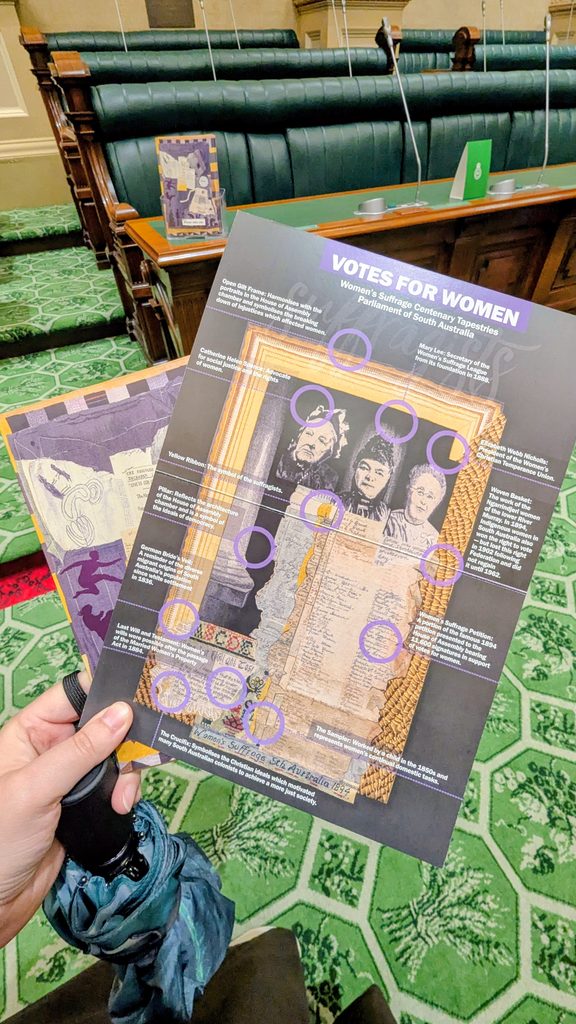
I also took the opportunity to join a free tour of South Australia’s Parliament House. It was interesting to hear about the women who campaigned for the vote and equal political rights. South Australia was the first Australian colony to grant women the right to vote, in 1894, and the first place in the world to allow women to stand for parliament. There is good reason for the state to be proud of that history.
Yet I couldn’t help noticing a contemporary contrast. In October 2025, Premier Peter Malinauskas described the question of housing trans-identified males in female prisons as a “niche issue”, following reports of an alleged assault on a female prisoner.
Of course, prison policy involves complex questions, but the safety and dignity of female prisoners are not niche concerns for the women affected. It struck me as a curious juxtaposition: a state that rightly celebrates the women who fought for their rights, while a contemporary question about women’s sex-based protections is characterised as a relatively low priority.
It was something I found myself reflecting on as I continued my visit.
An evening of conversation and connection
The conference dinner was a welcome opportunity to meet fellow advocates, make connections and exchange ideas. The evening began with a panel discussion featuring Irish psychotherapist Stella O’Malley, Brisbane-based clinical psychologist Dr Vanessa Spiller, and “M”, a mother speaking on behalf of Parents of Adolescents with Gender Distress. She withheld her full name to protect her child’s privacy.
The discussion covered some difficult questions: parents feeling excluded from decisions about their children, the role of therapy, social transition in schools and the need for careful clinical assessment.
As reported by The Australian, ‘M’ spoke about the pain and anger experienced by parents who feel sidelined by institutions. Dr Spiller discussed how court proceedings can provide an opportunity to scrutinise clinical practices and require professionals to substantiate their claims with evidence. She referred to the 2025 Re: Devin case involving the Royal Children’s Hospital gender clinic.
O’Malley was particularly critical of social transition in schools without parents’ knowledge, describing the practice as “incredibly pernicious”. Her advice to parents was direct:
“Wear your authority and wear it well.”
Her message was that parents need to be informed and involved in decisions affecting their children. No one knows a child better than their own parents, yet parents can find themselves sidelined when they question the approach being taken by a school or clinician.
This was one of the points that stayed with me. Parents should be able to ask questions, seek advice and consider different approaches without automatically being treated as an obstacle to their child’s wellbeing.
As a retired GP, I also found the discussion about clinical assessment important. Children experiencing distress deserve compassion and appropriate care, but that care must involve careful assessment, consideration of other possible explanations and a willingness to examine the evidence. No single approach should be assumed to be right for every child.
When women disagree: Stella O’Malley and Holly Lawford-Smith
Later in the evening, I enjoyed listening to a conversation between Stella O’Malley and philosopher Holly Lawford-Smith about the intersection of rights and the difficulties that arise when rights and interests come into conflict.

The two women had different perspectives. They agreed on some points and disagreed on others, but both expressed their views clearly and respectfully. They were able to challenge each other’s arguments without the discussion becoming personal.
For me, it was a pleasure to see two capable women engage with difficult questions in this way. Even when they disagreed, they remained polite and measured, putting their arguments across intelligently and allowing the discussion to develop.
In debates about sex, gender and rights, that is something worth appreciating. We don’t have to agree on everything to have a worthwhile conversation. We should be able to question arguments, acknowledge differences and explain our positions without shutting down debate or treating disagreement as a personal affront.
I found the exchange refreshing, and it was one of the highlights of the evening for me.
The conference continued on Saturday, with presentations from clinicians, academics, lawyers, former gender-clinic practitioners and people with lived experience, including neuropsychology professor Sallie Baxendale and former Tavistock clinicians Marcus and Sue Evans.
My first day in Adelaide had taken me from an art exhibition to the history of women’s suffrage, and then to conversations about children, parents, clinical practice and the intersection of rights. It was a varied and thought-provoking day.
I went to the conference to listen, learn and connect with others working on these issues. By the end of the evening, I had plenty to reflect on, and I was looking forward to the discussions ahead.