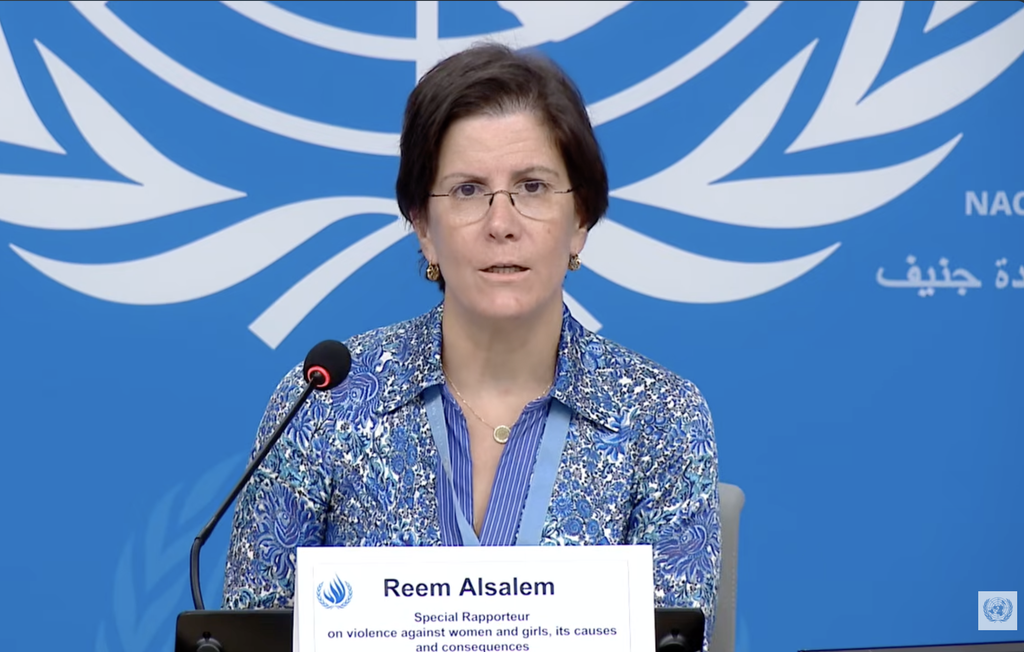
In June 2025, Reem Alsalem, the United Nations Special Rapporteur on violence against women and girls, its causes and consequences, presented a thematic report to the Human Rights Council: A/HRC/59/47, Sex-based violence against women and girls: new frontiers and emerging issues.
The report examines forms of violence against women and girls that are based on sex but which, in the Special Rapporteur’s assessment, remain insufficiently recognised, studied or addressed. It calls on States to ensure that sex is properly considered when understanding discrimination, preventing violence and responding to survivors.
At the same Human Rights Council session, Alsalem also presented A/HRC/59/47/Add.4, Overview of challenges and limitations of using the concept of consent in relation to violence against women and girls.
The two reports address different questions, but they are connected.
The first asks what happens when the material reality of sex is disregarded in understanding violence against women and girls.
The second asks what happens when consent is treated as a sufficient answer without examining the circumstances in which that consent was given.
Taken together, they raise two questions for law and policy: can the system accurately identify the people it is intended to protect? And can it distinguish genuine autonomy from coercion and exploitation?
These questions are particularly relevant to Australia, where debates concerning sex in anti-discrimination law, single-sex services and spaces, official data, sport, children’s medical treatment and the meaning of consent continue to develop.
Sex is the foundation of sex-based violence
The starting point is that women and girls experience particular forms of discrimination and violence because they are female. The report therefore begins from the material reality of sex.
As evolutionary biologist Richard Dawkins explains:
“Sex is a true binary. It all started with the evolution of anisogamy – sexual reproduction where the gametes are of two discontinuous sizes: macrogametes or eggs, and microgametes or sperm.”
Social roles may be constructed around sex. They do not replace the biological category.
The Committee on the Elimination of Discrimination against Women (CEDAW) has described gender as “the social meanings given to biological sex differences.” Violence against women and girls can be understood as gender-based violence precisely because those social meanings attach to sex.
Alsalem told the Council:
“International law recognizes that women and girls are female and that they are protected against discrimination based on their female sex.”
“Sex underpins the very definition of gender-based violence, as gender is a social meaning.”
If the category of sex is removed or replaced, the population experiencing sex-based harm becomes harder to identify.
“You cannot protect what you cannot define.”
What is lost when sex disappears?
Alsalem identifies a number of practical consequences when sex is conflated with gender, gender identity or other concepts.
The erosion of sex-specific language
Language determines what can be identified. Women, girls, females, mothers and lesbians describe particular populations. If those terms become indistinct, targeted protection and consistent data become harder.
Other categories can be useful. The issue is whether one category is used to replace another when they measure different things.
The loss of meaningful data
Sex-disaggregated data is essential in crime, violence, health, education, employment and sport.
If governments cannot reliably distinguish male and female populations in the data, they may lose the ability to identify sex-specific patterns of inequality and harm.
Failure to recognise sex-specific needs
Women and girls also have needs arising from female bodies — pregnancy, childbirth, menstruation, breastfeeding, the physical consequences of sexual violence — and circumstances in which safety, privacy and dignity depend on sex.
The question is not whether a service is “inclusive” in the abstract. It is whether it can still meet the needs for which it was established.
Single-sex spaces, services and lesbian boundaries
The implications extend beyond terminology and statistics.
Alsalem considers the consequences of disregarding sex in relation to single-sex spaces and services, particularly where women may require protection from male violence or where privacy and dignity are relevant.
The report discusses experiences in the United Kingdom in which women have reported intimidation, fear, loss of trust and concerns about the erosion of female-only provision. These examples illustrate a broader policy question:
What happens when a protection designed around sex can no longer rely upon sex as a meaningful criterion?
This question is particularly important for women who have experienced male violence.
It is also relevant to lesbians. A sexual orientation defined by attraction to the same sex necessarily depends upon the continued ability to identify the category of sex.
Girls, stereotypes and medicalisation
Alsalem draws attention to research reporting higher rates of autism among people presenting with gender dysphoria or gender incongruence, including findings that the odds were approximately three times higher, with particular attention to girls.
The report raises questions about the interaction between gender distress, stereotypes and the experience of the sexed body, particularly among girls.
The stakes are high because some medical interventions can have permanent or lifelong consequences.
Alsalem discusses potential consequences associated with medical interventions affecting sexual and reproductive development, including infertility and loss of the capacity to breastfeed following mastectomy.
The appropriate policy response is therefore not to assume that every child experiencing gender distress has the same needs or outcome.
New frontiers of sex-based violence
Sex-selective practices make the point plainly: where a female child is targeted because she is female, sex is the reason for the harm.
Digital technology adds new mechanisms — threats, sexualised abuse, harassment, image-based abuse, coordinated attacks. Alsalem cites research across 45 countries in which 85 per cent of women surveyed reported online violence.
Conflict and extreme repression are not Australian analogues. They show that the victim’s sex can be central to why the violence occurs.
Consent: when agreement is not the whole story
The Addendum addresses a related problem: apparent agreement does not necessarily resolve questions of violence or exploitation.
Consent is fundamental to bodily autonomy, but the circumstances in which it is given also matter. Alsalem examines coercion, manipulation, deception, fear, dependency and significant power imbalances. International legal frameworks concerning trafficking and the exploitation of prostitution also recognise circumstances in which consent is legally irrelevant.
The underlying principle is one of human dignity:
“You cannot consent to your own exploitation.”
The point is not that consent is meaningless. It is that consent cannot automatically legitimise exploitation or end the inquiry.
Asking “Did she consent?” may therefore be necessary, but it is not always sufficient. A proper assessment may also require asking:
- Was consent freely given?
- Was there coercion or manipulation?
- Was there a significant power imbalance?
- Was the person economically dependent?
- Was there deception?
- Could the person refuse without serious consequences?
- What exactly was consent given to?
- Was consent specific to that act?
- Has consent been withdrawn?
This distinction extends beyond conventional sexual violence. Alsalem considers contexts including prostitution, pornography, surrogacy and some forms of bodily intervention, where describing an arrangement as “chosen” can potentially obscure questions of power, exploitation, bodily integrity and human dignity.
Surrogacy illustrates the complexity. A contractual agreement may establish consent, but it does not by itself resolve questions about reproductive labour, economic pressure, physical risk, the interests of the child or the potential commodification of women’s reproductive capacity.
The broader principle is therefore:
Consent should be examined, but it should not be used to end the examination.
What do these reports mean for Australia?
These reports are not binding on Parliament. They supply tests. They invite policymakers to ask whether Australian law and policy remain capable of identifying sex-specific patterns of harm and protecting women and girls where sex is materially relevant.
Sex in anti-discrimination law
The 2013 amendments to the Sex Discrimination Act 1984 added gender identity and removed definitions of “man” and “woman.” In Giggle for Girls Pty Ltd v Tickle (Full Federal Court, 15 May 2026) the Court held that sex in the Act is not confined to a binary biological concept and is not immutable. Bills such as the Sex Discrimination Amendment (Sex-based Rights) Bill 2026 seek to restore biological definitions.
Single-sex services and spaces
Where safety or privacy depends on sex, the population must still be identifiable — in toilets and prisons, and in refuges, wards and change rooms.
Official data
The 2026 Census asks sex recorded at birth and, for those 16 and over, gender. Gender should not replace sex in crime, health and corrections data. Police-recorded sexual assault in Australia remains overwhelmingly a crime against females.
Sport
Sex differences can be relevant to fairness, safety and competitive opportunity. A framework incapable of distinguishing male and female populations will also struggle to measure sex-based disparities in sporting participation and outcomes.
Children and medical decision-making
Queensland and the Northern Territory have restricted new public puberty-blocker prescriptions. Where interventions may have irreversible or lifelong consequences, questions of capacity, informed consent, uncertainty, evidence and the best interests of the child should remain central
NHMRC interim advice on puberty suppression is expected in late 2026.
Exploitation and consent
Finally, Australian policymakers should be cautious about treating consent as an automatic answer to questions of exploitation.
The relevant question is not simply whether someone said yes. It is whether the surrounding circumstances made that agreement genuinely free and informed—and whether the activity itself raises independent questions of exploitation, dignity or harm.
Strengths and limitations of the reports
Strengths
A/HRC/59/47 makes an important methodological contribution by insisting that sex remains relevant to understanding violence against women and girls, particularly through sex-specific language, data, services, spaces and safety.
The Addendum complements this by challenging overly simplistic approaches to consent and emphasising coercion, power and exploitation. Together, the reports provide a useful framework for asking whether laws and policies intended to protect women remain capable of identifying the people and circumstances they are intended to protect.
Limitations
These reports are not systematic reviews of every disputed scientific question, nor are they model legislation, and some examples arise from jurisdictions and circumstances that differ significantly from Australia. Not every statement in a Special Rapporteur’s report should therefore be treated as settled scientific fact simply because it appears in a UN document.
Their value lies in identifying issues for serious examination; the appropriate response is to test those claims against evidence and assess their legal and policy implications carefully.
Conclusion
Reem Alsalem’s reports to the 59th session of the Human Rights Council provide a framework for examining two contested concepts in contemporary law and policy: sex and consent.
A/HRC/59/47 argues that disregarding the material reality of sex can weaken the ability to identify sex-specific patterns of violence, collect meaningful data and maintain appropriate protections for women and girls. The Addendum on consent similarly argues that consent cannot be separated from questions of coercion, power and exploitation.
Sex matters. Consent matters. But context matters too.
For Women Speak Australia, the significance of these reports is not that they provide ready-made answers to every Australian policy question, but that they raise questions that any effective rights framework should be able to answer:
Can the system identify the people it is intended to protect?
Can it identify the material circumstances that place them at risk?
And can it distinguish genuine autonomy from exploitation?
The task for Australia is neither to accept a UN report uncritically nor to dismiss it. It is to examine the evidence, preserve accurate categories, recognise material differences where they matter, and ensure that laws and policies intended to protect women and girls remain capable of doing so.