
Introduction
Access to safe, private and usable public toilets is an important but often overlooked aspect of participation in public life.
Across Australia, councils are increasingly considering different approaches to the design of public toilets and change facilities, including unisex and all-gender models. These approaches may provide benefits for some users, but they also raise questions about whether the particular needs of women and girls are being adequately considered.
In this article, Women Speak Australia introduces Sit100, a non-political women’s advocacy group based in the Lake Macquarie and Newcastle local government area, and shares research provided to us by the organisation examining the role of sex-segregated public sanitation.
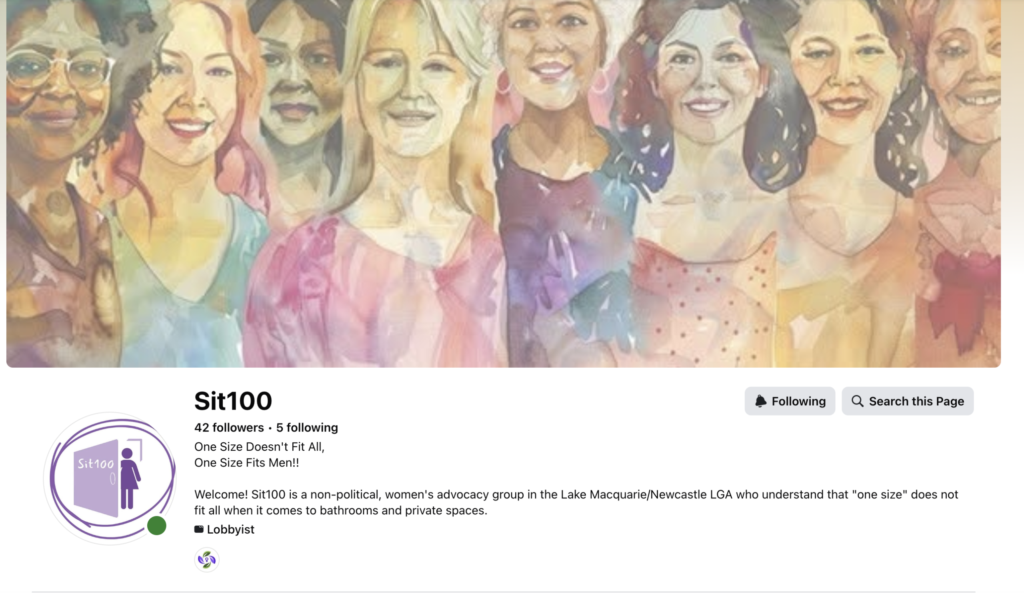
Sit100’s work focuses on women’s experiences of public toilets and change facilities, including questions of safety, privacy, dignity, hygiene, accessibility and equal participation in public life.
Women Speak Australia is partnering with Sit100 to help bring this research and the experiences informing it to a wider audience. The research paper discussed below was authored by J.S. Monaghan and J. Webster and was provided to Sit100 for use in its community advocacy and engagement.
Our purpose in sharing this material is to encourage informed discussion about public facility design and the importance of considering women’s needs when councils make decisions about public infrastructure.
Why Public Toilets Matter
Public toilets are essential infrastructure. They enable people to participate in community life, travel, work, attend sporting and cultural events, and use public spaces without having to return home whenever they need a toilet.
For women, access to appropriate facilities can be particularly important because of biological and life-stage considerations, including menstruation, pregnancy, childbirth, continence and ageing.
The research paper Equity of Access in Public Sanitation: Why Sex-Segregated Facilities Still Matter examines these issues and argues that replacing single-sex facilities with unisex-only provision can have unintended consequences for women.
The paper draws on existing research, clinical and health information, council strategies, parliamentary inquiries and surveys conducted by the authors, including research undertaken in the Lake Macquarie area.
Women’s Biological and Practical Needs
Women and men do not have identical biological or practical requirements when using public sanitation facilities.
Women generally need to sit to urinate, and women who are menstruating may require additional privacy, handwashing facilities and appropriate disposal arrangements. Pregnancy can also increase urinary frequency and urgency, while older women may experience increased continence issues and mobility difficulties.
The research provided by Sit100 considers how the cleanliness, privacy and design of public toilets can influence whether women feel able to use them comfortably.
Where facilities are perceived as unhygienic or unsafe, some women may choose to avoid them, delay using the toilet or alter their plans to ensure they have access to a facility they consider suitable.
These experiences are important considerations when assessing whether public infrastructure is genuinely accessible to everyone.
Menstruation, Pregnancy and Ageing
Menstruation is a normal biological process affecting a significant proportion of the female population throughout the reproductive years.
Appropriate menstrual hygiene requires privacy, access to water and handwashing facilities, and suitable disposal arrangements. Women may also need to manage menstrual products, menstrual cups or unexpected bleeding without feeling exposed or observed.
Pregnancy can create additional practical requirements, including more frequent and sometimes urgent access to toilets. For older women, continence, mobility and falls can become increasingly important considerations.
These are not questions of preference alone. They are examples of how biological differences can affect people’s interaction with public infrastructure.
Good public design should take those differences into account.
Privacy, Culture and Dignity
Privacy is another consideration raised in the Sit100 research.
For some women, sharing intimate facilities with men may conflict with cultural, religious or personal expectations around privacy. This can be particularly relevant for women from communities in which sex-separated facilities are customary or considered important.
Public infrastructure therefore needs to recognise that a single design will not necessarily work equally well for everyone.
Providing a range of appropriately designed facilities can allow councils to accommodate different needs without requiring one group to forgo facilities that are important to them.
What Is the Role of Local Government?
Local councils make many of the decisions that shape people’s everyday experience of public infrastructure.
When councils design or redevelop public toilets, swimming facilities, sporting facilities and change rooms, consultation and decision-making should consider the needs of the whole community.
This includes asking questions such as:
- What facilities do women and girls actually use and prefer?
- Have women been specifically consulted about proposed changes?
- Are privacy and safety considerations adequately addressed?
- Are menstrual hygiene needs incorporated into the design?
- Are facilities accessible to older people and people with disabilities?
- Are there suitable options for people who prefer or require all-gender or individual facilities?
- Has the community been given a genuine opportunity to comment on different design options?
Meaningful consultation is particularly important where a proposed change involves replacing an established single-sex facility with a different model.
Consultation should not assume the answer in advance. It should allow the community to express different views and should clearly communicate how those views have influenced the final decision.
A Range of Options Rather Than a Single Model
Importantly, the research does not argue that all-gender facilities should never exist.
Rather, the argument presented by Sit100 is that all-gender facilities should not necessarily replace single-sex facilities altogether.
A multi-option approach can provide greater flexibility. Individual accessible facilities, all-gender options and appropriately designed single-sex facilities can coexist, allowing people with different needs to choose the facility that is most appropriate for them.
This approach recognises that inclusion does not always mean creating one identical facility for everyone.
Sometimes, inclusion means providing different options so that people are not excluded by a one-size-fits-all approach.
A Local Example: Newcastle Ocean Baths
One example we discussed with Sit100 members is the community concept developed for Stage 2 of the Newcastle Ocean Baths revitalisation.
The concept, prepared by architect Peter Shaddock and endorsed by Friends of Newcastle Ocean Baths, retains traditional separate men’s and women’s change-room areas while incorporating additional design measures intended to improve privacy and accessibility.
The concept includes:
- separate entrances for men’s and women’s change rooms;
- a substantial dividing wall between hand-basin areas;
- dedicated accessible facilities; and
- additional inclusive facilities to accommodate different needs.
The proposal provides an example of how single-sex facilities and inclusive options can be considered together rather than treating them as mutually exclusive alternatives.
It also illustrates the value of community involvement in discussions about public infrastructure.
The broader principle is worth considering: good public design should begin with an understanding of how different members of the community actually use a facility.
Listening to Women’s Experiences
Public infrastructure can appear neutral on a plan while producing very different experiences for different groups of people.
Women may have concerns about privacy, hygiene, menstruation, pregnancy, continence, ageing or cultural expectations that are not immediately apparent when a facility is assessed only from an architectural or accessibility perspective.
For this reason, women’s experiences should form part of the evidence considered when councils make decisions about public toilets and change facilities.
This does not mean that women’s concerns should automatically determine every design decision. It means that those concerns should be properly heard, documented and weighed alongside the needs of other users.
Moving Forward
Women Speak Australia believes that public policy and infrastructure decisions benefit from open discussion, evidence and genuine community consultation.
The question of public toilets may appear relatively simple, but it raises broader issues about accessibility, equality, privacy, safety and participation in public life.
The research provided by Sit100 contributes to this discussion by documenting women’s experiences and examining the potential consequences of different approaches to public sanitation.
We encourage councils considering changes to public toilets and change facilities to:
- consult women directly about their experiences and preferences;
- consider biological, practical and cultural needs;
- assess privacy and safety alongside accessibility;
- provide appropriate single-sex facilities where there is a demonstrated community need;
- consider all-gender and individual facilities as additional options where appropriate; and
- clearly explain how community feedback has influenced the final design.
A genuinely inclusive approach does not necessarily require everyone to use the same type of facility.
It may instead mean providing a range of options that recognise the different needs of the people who use public spaces.
Document
The research paper Equity of Access in Public Sanitation: Why Sex-Segregated Facilities Still Matter was authored by J.S. Monaghan and J. Webster and has been provided to Sit100.