During a question-and-answer session following her Cockcroft Rutherford Lecture at Manchester University this week, former Australian Prime Minister Julia Gillard was directly challenged by Cath Dyson of the Women’s Rights Network. Dyson asked Gillard to reflect on her government’s 2013 amendments to the Sex Discrimination Act—changes that removed the Act’s biological definitions of “man” and “woman” and added “gender identity” as a protected attribute.
Dyson’s question reflected a growing debate in Australia about whether those reforms have contributed to legal conflicts involving women’s single-sex spaces, services, sports, and associations. Cases such as Tickle v Giggle have brought those tensions into sharp focus.
Gillard’s response was telling. She first suggested the matter might not interest a British audience, then stated:
“If you look at the Parliamentary debates in the changes to the Sex Discrimination Act in 2012, you’ll find that the issues you’re referring to were not raised by anyone. Because they simply weren’t a matter of public discourse the way they are today… It was a different time.”
It is certainly true that public discussion of these issues was far less extensive in 2012 and 2013 than it is today. However, the historical record suggests that concerns about the interaction between gender identity protections and female-only spaces were not entirely absent. The legislative process rested on contested policy foundations, received limited public scrutiny, and included warnings that closely resemble the disputes now playing out across Australia.
The Shaky Foundations: The 2009 Sex Files Report
The policy direction for the 2013 amendments was significantly shaped by the Australian Human Rights Commission’s 2009 “Sex Files” report — the concluding paper of the Commission’s Sex and Gender Diversity Project.
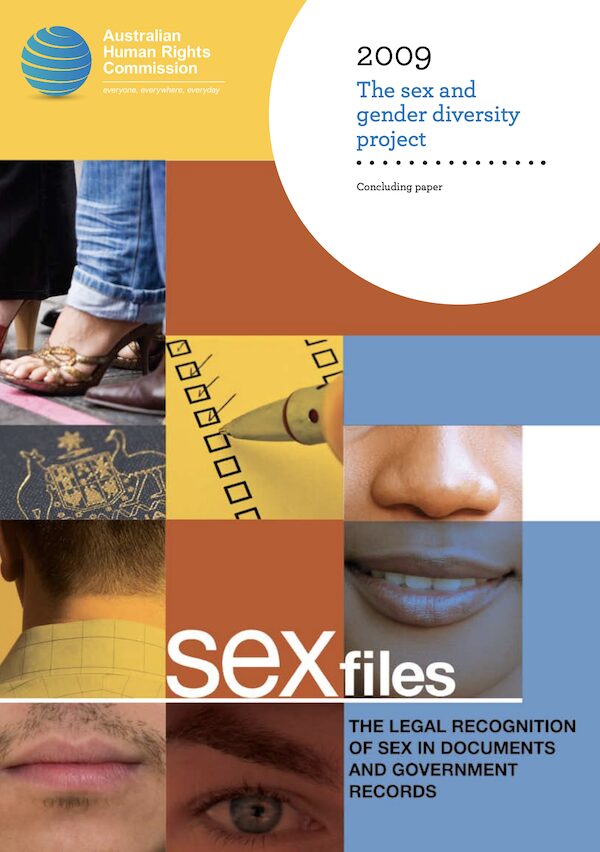
Although not legally binding, the report became an important reference point in subsequent policy development. Its consultation process relied heavily on engagement with sex and gender diverse communities through public meetings and an online consultation process. The report itself acknowledged that there was “no consensus about the definition of sex or gender” across legal, social, medical, and scientific frameworks.
Despite recognising this lack of consensus, the report recommended greater recognition of self-identified sex and gender identities and drew on frameworks such as the Yogyakarta Principles—a set of non-binding principles developed by human rights experts and activists in 2006.
In Section 4, the report outlined competing understandings of sex and gender. It described the traditional view that sex is biologically determined and distinct from gender, while also presenting perspectives that reject or collapse that distinction. The report ultimately favoured reforms that placed greater emphasis on identity-based understandings of sex and gender.
What is notable in retrospect is that the report appears to have focused primarily on the experiences and concerns of sex and gender diverse communities. There is comparatively little discussion of how proposed reforms might affect women’s sex-based rights or generate conflicts between competing protected interests. This identity-first approach helped shape the policy environment that preceded the 2013 amendments.
The 2013 Process: Limited Scrutiny and Explicit Warnings
When the Gillard Government introduced the Sex Discrimination Amendment (Sexual Orientation, Gender Identity and Intersex Status) Bill 2013, the legislation proceeded through Parliament with relatively limited public attention compared with the significance of the changes being proposed.
A Freedom of Information request by the Affiliation of Australian Women’s Advocacy Alliances (AAWAA) later revealed that the Office for Women held no records relating to advice, briefings, or consultations on the proposed amendments. Responsibility for the reforms appears to have rested primarily with the Attorney-General’s Department.
Most importantly, the potential impact on female-only spaces was not entirely unforeseen.

The Warning Was Explicit
The Senate Legal and Constitutional Affairs Legislation Committee recorded evidence from the Attorney-General’s Department at paragraph 3.37 of its report:
“Exclusion of a trans woman from a female-only club could constitute gender identity discrimination. The department considers the current drafting will achieve this intention.”
This statement is significant because it demonstrates that at least one of the core conflicts now dominating public debate was identified during the legislative process itself.
Whether one supports or opposes the policy outcome, the possibility that gender identity protections could affect female-only spaces was not entirely hypothetical. It was expressly contemplated by the department responsible for drafting and advancing the legislation.
At the same time, the explanatory memorandum accompanying the Bill confirmed that the amendments would remove the Act’s existing statutory definitions of “man” and “woman” while introducing gender identity as a protected attribute.
Supporters of the reforms argued that these changes were necessary to strengthen protections against discrimination for transgender Australians and to modernise federal anti-discrimination law. Critics, however, warned that the reforms risked creating conflicts between gender identity protections and sex-based rights. The parliamentary record indicates that at least some of those concerns were raised at the time.
Gillard’s Defence Versus the Record
Gillard now argues that these issues were not raised during parliamentary debates because they were not part of public discourse in the way they are today.
In Manchester she stated:
“It wasn’t something squarely before the parliament at the time that the legislation was being amended. So I think we make an error in uplifting what we know now and public discourse now and just putting it down 14 years ago.”
There is some truth in that observation. Few people in 2013 anticipated the scale of the debate that would emerge over the following decade.
However, the parliamentary record suggests that the possibility of conflict between gender identity protections and female-only spaces was not entirely absent from consideration. The Attorney-General’s Department explicitly identified such a scenario during the legislative process.
The issue, therefore, may not be that no warnings existed. Rather, it is whether those warnings received sufficient scrutiny and whether competing interests were adequately weighed before the law was changed.
Real-World Consequences
More than a decade later, many of the questions that were once theoretical have become practical legal and political disputes.
In Tickle v Giggle, the Federal Court concluded that the Sex Discrimination Act does not confine the concept of sex to biological characteristics and found that Roxanne Tickle was entitled to protection under the Act. The case became a focal point for broader debates about the relationship between gender identity protections and women’s single-sex spaces.
Similar disputes have emerged in relation to women’s sports, lesbian organisations, correctional facilities, domestic violence services, and other sex-segregated settings.
This week, the Albanese Government, with the support of the Greens, voted against allowing two Senate bills to proceed. One was the Sex Discrimination Amendment (Restoring Common Sense and Recognising Biological Sex) Bill 2026, introduced by Liberal Senator Michaelia Cash. The other was Senator Pauline Hanson’s Sex Discrimination Amendment (Acknowledging Biological Reality) Bill 2024, which One Nation sought to revive. Both sought to restore biological definitions of sex and strengthen legal protections for female-only spaces.
Women’s advocates have argued that the legal consequences of the 2013 reforms are now clear and require legislative correction. Sall Grover has stated that regardless of Parliament’s intentions in 2013, lawmakers now have the benefit of hindsight and should respond accordingly.
Time for a Reckoning
The strongest challenge to Gillard’s “different time” defence is not that public debate in 2013 mirrored today’s debate. It plainly did not.
The stronger argument is that at least some of the conflicts now attracting public attention were foreseeable and, in fact, were foreseen. The documentary record shows that questions about female-only spaces and gender identity protections were raised during the legislative process itself.
Whether Parliament reached the right conclusion in 2013 remains a matter of political disagreement. What is no longer disputable is that the consequences of those reforms are now being tested in courts, sporting organisations, public institutions, and legislatures across Australia.
The Albanese Government now faces a question that previous governments largely avoided: how should the law balance protections for transgender individuals with protections based on biological sex?
A mature democracy should be willing to revisit laws when experience reveals unintended consequences, unresolved tensions, or inadequate safeguards. More than a decade after the amendments were passed, the debate is no longer hypothetical. It is here, it is ongoing, and it deserves open and serious consideration.
Australian women deserved a thorough public conversation in 2013. They deserve one now.