Midwifery practice in Australia is governed by national law and professional standards that place women at the centre of care. The primary legislation is the Health Practitioner Regulation National Law, which establishes the Nursing and Midwifery Board of Australia (NMBA). The NMBA’s Midwife standards for practice (2018) explicitly state that the standards “are framed within a woman-centred approach” and define woman-centred care as considering “the woman’s individual circumstances, and aims to meet the woman’s physical, emotional, psychosocial, spiritual and cultural needs.”
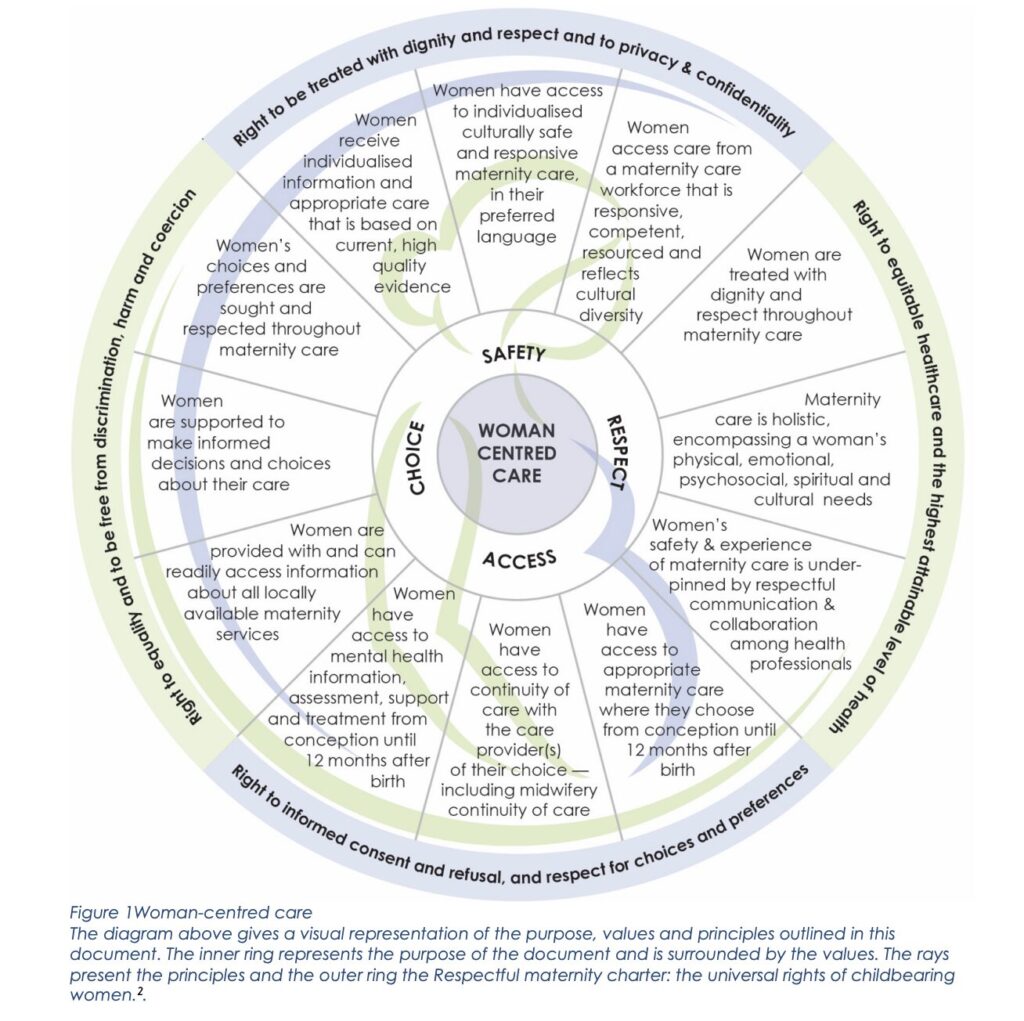
This national approach is reinforced by the Commonwealth Government’s key policy document: Woman-centred care: Strategic directions for Australian maternity services (2019). The Strategy sets the overarching direction for maternity services across Australia and states:
“Woman-centred care: Strategic directions for Australian maternity services (the Strategy) provides overarching national strategic directions to support Australia’s high-quality maternity system… Women are the decision-makers in their care and maternity care should reflect their individual needs.”
The document consistently uses the language of “woman” and “women” throughout. In its section on language and scope, it clarifies:
“In the Strategy, the term ‘woman’ or ‘women’ is inclusive of the woman’s baby or babies, partner, family and community… The Strategy is based on the understanding that maternity care is inclusive of the diverse experiences of women, including their social circumstances…, cultural and religious background, health, disability, sexual orientation and the gender with which they identify.”
This single reference to gender identity appears as one element in a broader list of diversity considerations. It sits inside a framework that remains firmly woman-centred. The Strategy does not replace the term “woman” with neutral language, nor does it instruct services to adopt gender-neutral terminology such as “birthing people” or “pregnant people.” Acknowledging diversity — including gender identity — does not change or dilute the woman-centred foundation.
Neutral Language Is Creeping into Midwifery Roles
Despite the clear national framework, many public hospitals have introduced gender-neutral or highly generic language into midwife Position Descriptions and recruitment materials in recent years. These changes appear to be driven at the local level by hospital Human Resources departments, often through standardised templates that apply the same wording to both nursing and midwifery roles.
A clear example is the Eastern Health Registered Nurse / Midwife Position Description (2026). The document repeatedly refers to care for “people (individuals, families, groups and communities)”, “person-centred care”, and “patient and family centered care”. The word “woman” appears only once in the entire document — and only as a footnote in the definition of the term “Patient”:
“Throughout this position description, Patient includes the following: consumer, woman, resident, client.”
Beyond this single reference, the language remains deliberately neutral. The document does not use the words “mother” or “mothers” at all. As a result, the Position Description reads more like a generic advertisement for a general practice or community health nursing role than a specialised midwifery position focused on pregnancy, birth, and the care of women as mothers.
An Emerging Pattern
Similar patterns are emerging in other states. In New South Wales and Queensland, some midwife job advertisements and Position Descriptions mix traditional language with “person-centred care” and “family-centred care” as the dominant framing. In certain services, the term “birthing people” has also begun to appear alongside or instead of “women”.
The same pattern can be seen in some hospital promotional materials. In one video produced by a major Victorian maternity hospital, a midwife refers to preparing the birth room for the arrival of the “birthing person” rather than the mother or woman. While some parts of the same video still use the word “woman”, the introduction of neutral terminology in official communications contributes to the gradual erosion of clear, woman-centred language.
Midwives Themselves Are Concerned
This shift has not gone unnoticed by midwives working on the ground. We have been contacted by several midwives who have expressed serious concerns about the increasing use of gender-neutral language in job advertisements, position descriptions, and hospital communications. The Australian College of Midwives has also surveyed its members on the impact of “losing mother and women from our language and scope,” highlighting that this is a live issue within the profession itself.
Restoring Clarity in Women’s Health Services
The national legal and policy framework for midwifery in Australia is clear: care is designed to be woman-centred. Acknowledging diversity, including gender identity, does not require removing the word “woman” or replacing it with neutral alternatives.
In practice, however, some hospital human resources departments and local health services have introduced gender-neutral language into midwife position descriptions and public materials. These local decisions are not required by the Health Practitioner Regulation National Law or by the Commonwealth’s Woman-centred care Strategy.
Clear and accurate language matters. Midwifery is specialised care grounded in the biological reality of female reproduction. When official documents obscure that reality, it can create confusion for women — particularly first-time mothers and those from culturally and linguistically diverse backgrounds — about who the services are primarily intended to support.
Hospitals and health services should review their position descriptions and public materials to ensure they remain consistent with national woman-centred standards. Professional bodies, midwives, and women’s organisations all have a role in protecting the clarity and integrity of women’s health services.
Women Speak Australia supports the retention of accurate, woman-centred language in maternity care as part of protecting the sex-based rights of women, recognising the unique role of motherhood, and promoting evidence-based policy in services that exist for women and their babies.