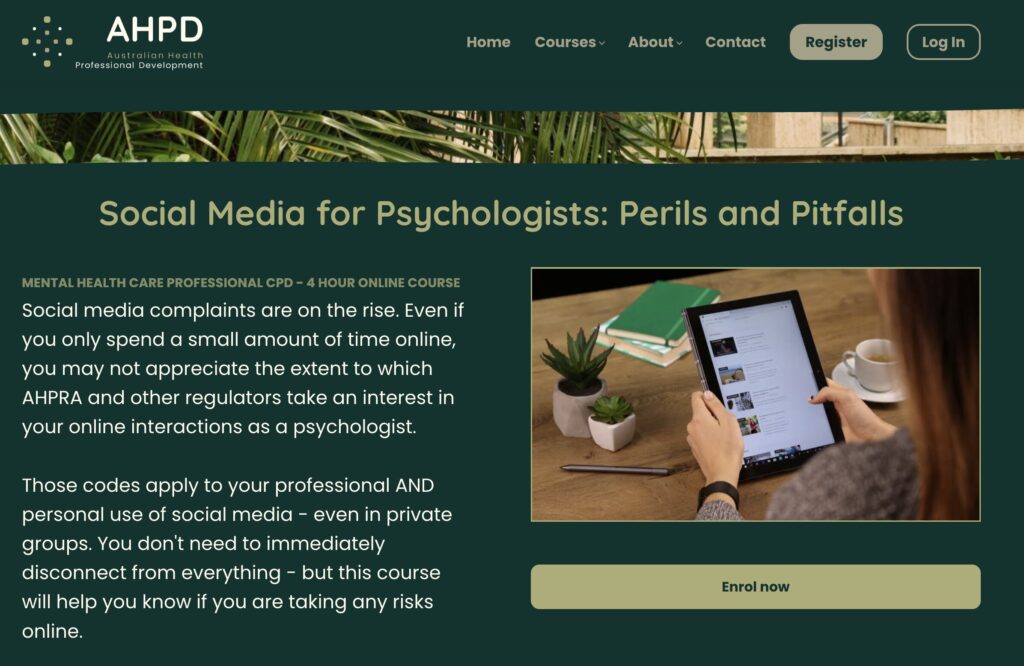
Recently, doctors and psychologists have drawn attention to a new online workshop titled “Social Media for Psychologists: Perils and Pitfalls” offered by Australian Health Professional Development (AHPD), a provider of continuing professional development (CPD) education for health practitioners. According to the course description, complaints arising from social media activity are increasing, and practitioners are warned that even personal or private group activity may attract regulatory scrutiny.
This is a concerning development—not because of the seminar itself, but because of what it represents.
When registered health practitioners require dedicated continuing professional development (CPD) training on how to safely navigate social media, for fear that their online activity may trigger a complaint or regulatory investigation, something has gone seriously wrong with the regulatory environment. Professional development should primarily focus on improving clinical skills, patient care, and professional knowledge—not on helping practitioners avoid becoming the subject of complaints for lawful online expression.
The existence of a course such as “Social Media for Psychologists: Perils and Pitfalls” suggests that many practitioners perceive genuine regulatory risk in participating in online discussion. That perception alone warrants closer examination of the framework that has created it.
The Expanding Role of AHPRA in Online Speech
The Australian Health Practitioner Regulation Agency (AHPRA) and the National Boards were established to protect the public by ensuring that only competent and ethical practitioners are registered to practise. Their core role is patient safety—addressing unsafe clinical practice, breaches of confidentiality, sexual misconduct, fraudulent conduct, and other forms of professional misconduct.
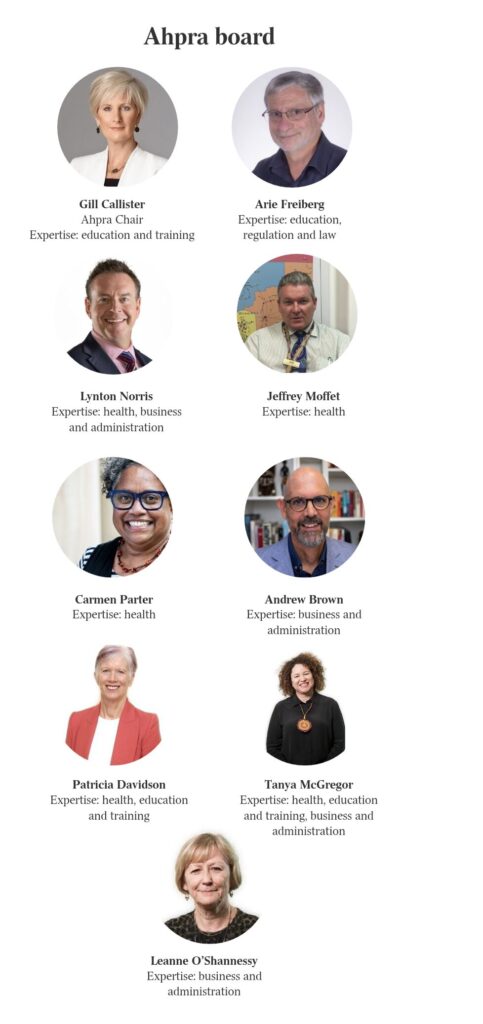
In recent years, however, AHPRA has increasingly extended its regulatory framework to practitioners’ online presence and public expression. Through its Social Media Guidance and Codes of Conduct, professional obligations now apply not only in clinical settings but also to personal social media activity and public commentary.
AHPRA’s guidance contains an important statement:
“Ahpra and the National Boards recognise the freedom of expression for practitioners and their right to communicate, including advocating for causes via social media, provided their activities do not involve the abuse or discrimination of others, or present a risk to the public.”
This recognition of freedom of expression is welcome and reflects an important democratic principle. Health professionals should be able to contribute to public discussion, engage in scientific debate, and advocate for causes without fear of regulatory intervention simply because their views are controversial or unpopular.
However, the guidance also states that regulatory action may be considered where a practitioner’s expression:
- presents a risk to public safety;
- provides false or misleading information or breaches privacy or confidentiality;
- risks the public’s confidence in their profession; or
- requires action to maintain professional standards.
The first two categories are relatively clear. The latter two are not.
Where the Guidance Becomes Subjective
The concepts of “public confidence in the profession” and “maintaining professional standards” are inherently difficult to define and measure objectively.
Unlike patient harm, confidentiality breaches, fraudulent conduct, or unsafe clinical practice, public confidence is not a fixed or measurable standard. The guidance does not clearly explain whose confidence is being assessed, how that confidence is measured, or what threshold must be crossed before lawful speech becomes grounds for regulatory intervention.

In a diverse society, particularly on matters involving evolving science, health policy, ethics, and public debate, people will inevitably disagree. A statement that causes one group to lose confidence in a practitioner may increase the confidence of another.
This creates significant uncertainty for practitioners attempting to participate in public discussion while remaining compliant with professional obligations.
The result is a framework that appears to grant broad discretion to regulators while providing limited certainty to practitioners.
The Human Impact of Complaints and Investigations
This concern is not merely theoretical.
AHPRA has itself acknowledged the significant psychological impact that complaints and investigations can have on practitioners. Public reporting and commissioned reviews have identified cases in which health practitioners who were subject to regulatory processes later died by suicide. While individual circumstances are often complex and causation cannot be assumed, these findings have prompted widespread calls for reforms to complaints handling, practitioner support, and procedural fairness.
Even where no adverse finding is ultimately made, the existence of an investigation can impose substantial professional, financial, and psychological burdens. Legal costs, reputational damage, professional uncertainty, and prolonged stress often occur long before any determination is reached.
The recent case of Dr Andrew Amos has further intensified concerns regarding the role of non-patient complaints, the use of immediate regulatory action, and the extent to which lawful public commentary can become the subject of professional scrutiny. Regardless of one’s views on the underlying issues, the case has prompted broader questions about procedural fairness, proportionality, and the limits of regulatory authority.
Why This Matters
Perhaps the most revealing aspect of this issue is not any individual case, but the existence of courses such as “Social Media for Psychologists: Perils and Pitfalls” in the first place.
When a market emerges to teach health professionals how to safely navigate social media complaints and regulatory investigations, it suggests that many practitioners perceive genuine risk in participating in public discussion.
That should concern everyone.
Professional regulation exists to protect patients and maintain standards of care. It should not create an environment in which practitioners feel compelled to self-censor for fear that lawful expression may trigger complaints, investigations, or disciplinary action.
A profession that fears speaking openly is less likely to engage in robust scientific debate, challenge prevailing assumptions, or contribute honestly to important public conversations. Scientific progress depends upon the ability of professionals to question, discuss, and debate ideas without undue fear of regulatory consequences.
WSA Writes to AHPRA
Women Speak Australia has written formally to AHPRA CEO Justin Untersteiner expressing concerns about the regulator’s social media framework and seeking clarification on several issues, including:
- How AHPRA objectively assesses impacts on “public confidence”;
- What safeguards exist to prevent complaints being used to suppress legitimate scientific, professional, or policy debate;
- Whether the absence of patient harm or any therapeutic relationship is adequately considered before investigations proceed; and
- The limits of AHPRA’s authority to regulate lawful speech outside clinical settings.
Public safety must remain the priority of professional regulation. However, protecting the public should not come at the expense of intellectual freedom, scientific inquiry, procedural fairness, or practitioner wellbeing.
We believe it is time for a comprehensive review of AHPRA’s social media guidance and broader regulatory approach.
Women Speak Australia will continue to advocate for proportionate, transparent, and accountable regulation that protects patients without discouraging legitimate public debate.